The Lamb of God — one phrase, traced to its root
John says four words — “Behold the Lamb of God” — and every Jew standing there would have heard two older passages at once. Here is how you find them.
“Why lamb? Why not sheep? And when John said it, what were his hearers supposed to remember?” That question needs Greek, Hebrew and a concordance. It used to need a shelf of books and an afternoon. Below it takes four questions.
The grey “behind the scenes” rows are collapsed on purpose. Those are the calls your AI makes for you — you never type them. You ask in plain words (“what’s the Greek for lamb here, and where else does it appear?”); the assistant picks the tools, reads what comes back, and answers you in ordinary language. Open any one of them to see exactly what was run, and repeat it yourself.
These are deliberately light examples — a handful of calls, laid out in order so they are easy to follow. In real use your AI chains dozens in a single reply: parse the verse, pull every Strong’s entry in it, fan out through the cross-references, check each in four lexicons, weigh the lot — then speak. At around 38 ms a call, you never notice it happening.
This study follows one question, and then stops. You would not. Whatever it opens — a word you want to chase through the rest of Scripture, a parsing you do not believe, a cross-reference that looks wrong — you can simply say so and keep going, for as long as the subject holds you. Ask it to argue the other side. Ask what would disprove it. Nothing here is a fixed path; it is one thread pulled far enough to see where it leads, written up so it can be read.
John the Baptist sees Jesus and makes the declaration that frames the entire Gospel:
“The next day John seeth Jesus coming unto him, and saith, Behold the Lamb of God, which taketh away the sin of the world.” — John 1:29
The AI ran a complete verse study — morphological parsing of all 21 Greek words.
Behind the scenes — what your AI actually ran
→ 21 words parsed · 16 Strong’s numbers · 65 cross-references
| Greek | Parsing | Strong’s | Meaning |
|---|---|---|---|
| ιδε | Verb, 2nd Aorist, Active, Imperative | G2396 | “Behold!” — a command to look |
| ο αμνος | Noun, Nominative Sing. Masc. | G286 | “the Lamb” — LXX equivalent of Hebrew כבש |
| του θεου | Noun, Genitive Sing. Masc. | G2316 | “of God” — genitive of possession |
| ο αιρων | Verb, Present Active Participle | G142 | “the one taking away” — ongoing action |
| την αμαρτιαν | Noun, Accusative Sing. Fem. | G266 | “the sin” — singular, collective: all of it |
| του κοσμου | Noun, Genitive Sing. Masc. | G2889 | “of the world” |
The AI traced the Greek word for lamb back to its Hebrew origin.
Behind the scenes — what your AI actually ran
→ αμνός (amnos) = a lamb
→ Abbott-Smith: “in LXX chiefly for כבש”
→ LSJ (classical Greek): “lambs in temper” — metaphor for gentleness
→ Used only 4 times in NT: John 1:29, John 1:36, Acts 8:32, 1 Peter 1:19
Darash returned 65 cross-references for John 1:29. Four point directly into the Torah:
Behind the scenes — what your AI actually ran
→ 65 cross-references
→ Torah links: Genesis 22:7-8, Exodus 12:3, Leviticus 16:21-22, Numbers 28:3-10
“And Isaac spake unto Abraham his father, and said, My father: and he said, Here am I, my son. And he said, Behold the fire and the wood: but where is the lamb for a burnt offering?” — Genesis 22:7
“And Abraham said, My son, God will provide himself a lamb for a burnt offering: so they went both of them together.” — Genesis 22:8
“They shall take to them every man a lamb … Your lamb shall be without blemish, a male of the first year.” — Exodus 12:3,5
Behind the scenes — what your AI actually ran
“And Abraham said, My son, God will provide himself a lamb for a burnt offering: so they went both of them together.”
The word rendered “a lamb” is הַשֶּׂה — ha-seh, H7716, with the definite article. Not a lamb. The lamb.
| Hebrew | Strong’s | Lexicon | Occurrences |
|---|---|---|---|
| שֶּׂה śe | H7716 | “one of a flock — lamb, sheep, goat” | 39× in the Old Testament |
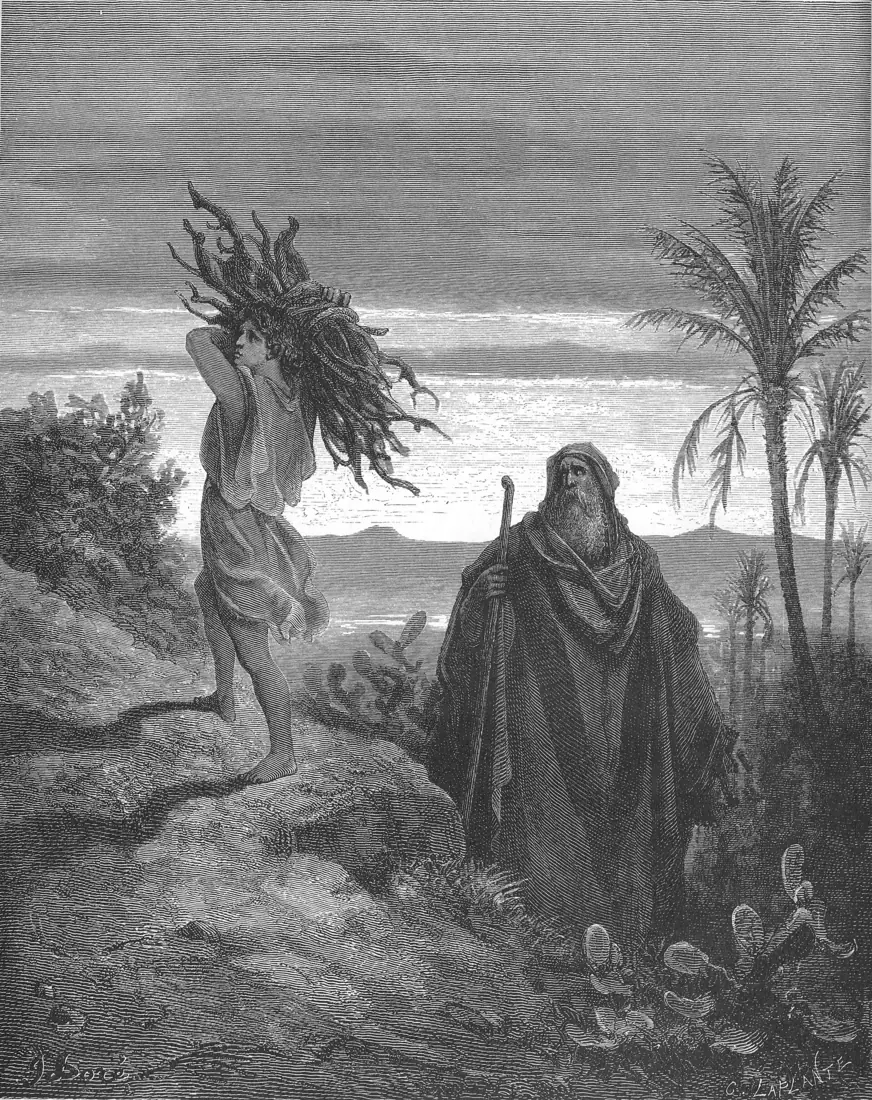
Abraham does not promise a sheep. He names a specific creature that God will provide — and then walks up the mountain without one.
Behind the scenes — what your AI actually ran
“…they shall take to them every man a lamb, according to the house of their fathers, a lamb for an house.”
The word for “lamb” here is שֶׂה — seh, H7716. The identical noun Abraham used. The lamb Abraham said God would provide is the same word as the lamb every household is now commanded to take.
This is not an interpretation laid over the text. It is the same Strong’s number, and you can check it in one call.
Behind the scenes — what your AI actually ran
New Testament Greek has an ordinary, everyday word for a sheep. John did not use it.
| Greek | Strong’s | Times in the NT | Where |
|---|---|---|---|
| ἀμνός amnós | G286 | 4 | John 1:29, John 1:36, Acts 8:32, 1 Peter 1:19 |
| πρόβατον próbaton | G4263 | 36 | the ordinary word for a sheep, throughout |
All four uses of ἀμνός in the entire New Testament are about Christ as a sacrifice. Abbott-Smith notes it is used “fig., of Christ” and that the Septuagint uses it chiefly for כֶבֶׂש, the sacrificial lamb. Acts 8:32 is Philip reading Isaiah 53 to the Ethiopian; 1 Peter 1:19 is “a lamb without blemish and without spot.”
John had a common word available and reached past it for a rare one that the Greek Old Testament had already loaded with sacrifice. That is the whole sermon, and it is sitting in a word count.
Behind the scenes — what your AI actually ran
Why this call, next. Steps 4–6 established that John chose a rare word. That is only interesting if the rarity holds up, so the next move is not interpretation — it is a census. Fetch all four occurrences and read them, because a claim about a word’s meaning that has not looked at every place it stands is a guess wearing a citation.
Four occurrences, and not one of them is about livestock:
| Where | Greek | What is being said |
|---|---|---|
| John 1:29 | ἀμνός | “Behold the Lamb of God, which taketh away the sin of the world” |
| John 1:36 | ἀμνός | “Behold the Lamb of God!” — said again, the next day |
| Acts 8:32 | ἀμνός | the Ethiopian’s scroll: “like a lamb dumb before his shearer” |
| 1 Peter 1:19 | ἀμνοῦ | “the precious blood of Christ, as of a lamb without blemish” |
A word used four times in the New Testament, every time of one person, and twice by the same man in two days.
Behind the scenes — what your AI actually ran
Why this call, next. One of those four, Acts 8:32, turned out to be a quotation — so it is not really a fifth witness, it is a pointer. Follow the pointer. The Ethiopian is reading Isaiah in Greek; the question is what stands underneath in Hebrew, and whether it connects to the noun found back in step 4. This is the only call in the chain that could have collapsed the argument — if Isaiah 53:7 used a different word, the thread would simply end here.
Acts 8:32 is a quotation. Follow it back to the Hebrew and the thread closes:
“A lamb” there is כַּשֶּׂה — ka-seh, H7716. The same noun as Genesis 22:8 and Exodus 12:3. Not a similar word, not a synonym — the identical Strong’s number.
And one word earlier: נַעֲנֶה naʿəneh, H6031 — “he was afflicted.” That is the verb the Torah uses when it commands Israel to afflict her soul on the Day of Atonement. On the day the nation humbles itself, and of the servant who is humbled for them, Scripture reaches for one word.
Behind the scenes — what your AI actually ran
Why this call, next. The thread closed, which raises the opposite risk: seeing one word everywhere. So test it adversarially — go where the Lamb is most prominent, Revelation, and check whether the same word is used. If it were, that would weaken the case that John 1:29 is a deliberate reach. It is not the same word, and the difference turns out to say something.
In Revelation the Lamb is not ἀμνός at all. John switches to ἀρνίον G721 — arníon, which the lexicon glosses simply as “a lambkin”: the diminutive, the little lamb. He uses it 27 times.
The sacrificial word belongs to the altar. The word for the Lamb on the throne, receiving power and riches and wisdom, is the tender one. That is a deliberate authorial choice, and you can see it because you counted.
It is worth being plain about what changes when an assistant has Darash in front of it, because the failure mode without one is specific and well known.
| Answering from training | Answering through Darash | |
|---|---|---|
| Where the answer comes from | a statistical impression of text seen during training | a lookup in the actual corpus, returned as data |
| A Strong’s number | generated token by token — H7716 and H7761 are equally easy to produce, and both look right | returned by the tool or not returned at all |
| A frequency claim | “appears only a handful of times” — vague because the number was never counted | 39×, because something counted |
| Being wrong | reads exactly like being right | usually surfaces as an empty result or a mismatch |
| Checking it | you must already know the answer | re-run the call |
The mechanism is simple. A language model asked for a Strong’s number from memory is doing the same thing it does when writing a sentence: producing the most plausible next token. Plausible is not the same as true, and for a five-character identifier the difference is invisible — there is no internal signal that separates a remembered H7716 from an invented one. That is the whole of the hallucination problem in one line: fluency is uncorrelated with accuracy.
A lookup breaks that. The number is no longer generated, it is fetched; the frequency is no longer estimated, it is returned. The model’s job drops from “recall the lexicon” to “read this entry and explain it” — a far easier task, and one it is good at. Errors become the ordinary kind: a wrong call, a misread field, an overreach in the wording. Those are visible and correctable. Confident fabrication is not.
This is also why every claim on this page carries its Strong’s number. Not decoration — a handle, so you can go and check whether these things are so.
One noun carries the whole promise
We began with four English words in John 1:29 and asked what a first-century Jew would have heard. What came back was a single Hebrew noun, שֶׂה śeh H7716, standing at three separate hinges of Scripture:
| Passage | Word | What it does there |
|---|---|---|
| Genesis 22:8 | הַשֶּׂה H7716 | a promise left open on a mountain — God will provide the lamb |
| Exodus 12:3 | שֶׂה H7716 | the promise made a command to every household |
| Isaiah 53:7 | כַּשֶּׂה H7716 | the lamb turns out to be a person, silent before his shearers |
Then the Greek takes over. The Septuagint had already loaded ἀμνός with sacrifice, so when John points at a man and uses it — passing over πρόβατον, the ordinary word, which the New Testament uses 36 times — he is not being poetic. He is naming which lamb. And in the only four places that word appears, it is always this one person.
The honest limits. Śeh occurs 39 times in the Old Testament; most are ordinary livestock, and nobody should pretend otherwise. The argument is not that the word is rare — it is that these three passages are the ones the New Testament itself reaches back to, and they share it. Nor does any of this prove a doctrine. It shows that the vocabulary was already in place, and that the writers knew exactly which shelf they were taking it from.
None of this required a special engine or a novel method. It required reading the words that are there, in the order they were written, and being willing to count.
How this study was actually made. It was run — not composed from memory — by Claude Opus 5 driving Darash over MCP. Thirteen tool calls: get_verse ×5, get_morphology ×6, word_study ×3, get_cross_refs ×1. Median call 37 ms; 535 ms for the entire chain. Every Strong’s number, frequency count and lexicon gloss on this page came back from one of those calls, and every one of them is reproducible by you.
The chain above is the light version, written out so it reads. Turned loose on the same question an assistant will make many more calls than this — and at 37 ms each you would never know.
Thirteen lookups. Half a second. An afternoon’s work.
Every command above is real and repeatable — the morphology, the Strong’s entries, the Abbott-Smith citation, the cross-references. Darash connects over MCP, an open standard, so it runs inside Claude, ChatGPT, Cursor or whatever you already use. The sources are the public-domain classics scholars have leaned on for a century.
See plans Browse the library