The Cross — why they called it a tree
The New Testament has two words for what Jesus died on, and the writers switch between them deliberately. The switch is the argument.
“Why does Peter say hanged on a tree when there was a perfectly good word for a cross?” Because of a line in Deuteronomy — and you can watch the quotation being made.
The grey “behind the scenes” rows are collapsed on purpose. Those are the calls your AI makes for you — you never type them. Open any one to see what was run and repeat it.
This study follows one question, and then stops. You would not. Whatever it opens — a word you want to chase through the rest of Scripture, a parsing you do not believe, a cross-reference that looks wrong — you can simply say so and keep going, for as long as the subject holds you. Ask it to argue the other side. Ask what would disprove it. Nothing here is a fixed path; it is one thread pulled far enough to see where it leads, written up so it can be read.
Behind the scenes — what your AI actually ran
σταυρός staurós G4716, 28 occurrences. Abbott-Smith orders the senses historically, and the order is worth noticing:
| Sense | Abbott-Smith |
|---|---|
| 1 | “an upright pale or stake” — Homer, Herodotus, Thucydides |
| 2 | “in late writers… of the Roman instrument of crucifixion” |
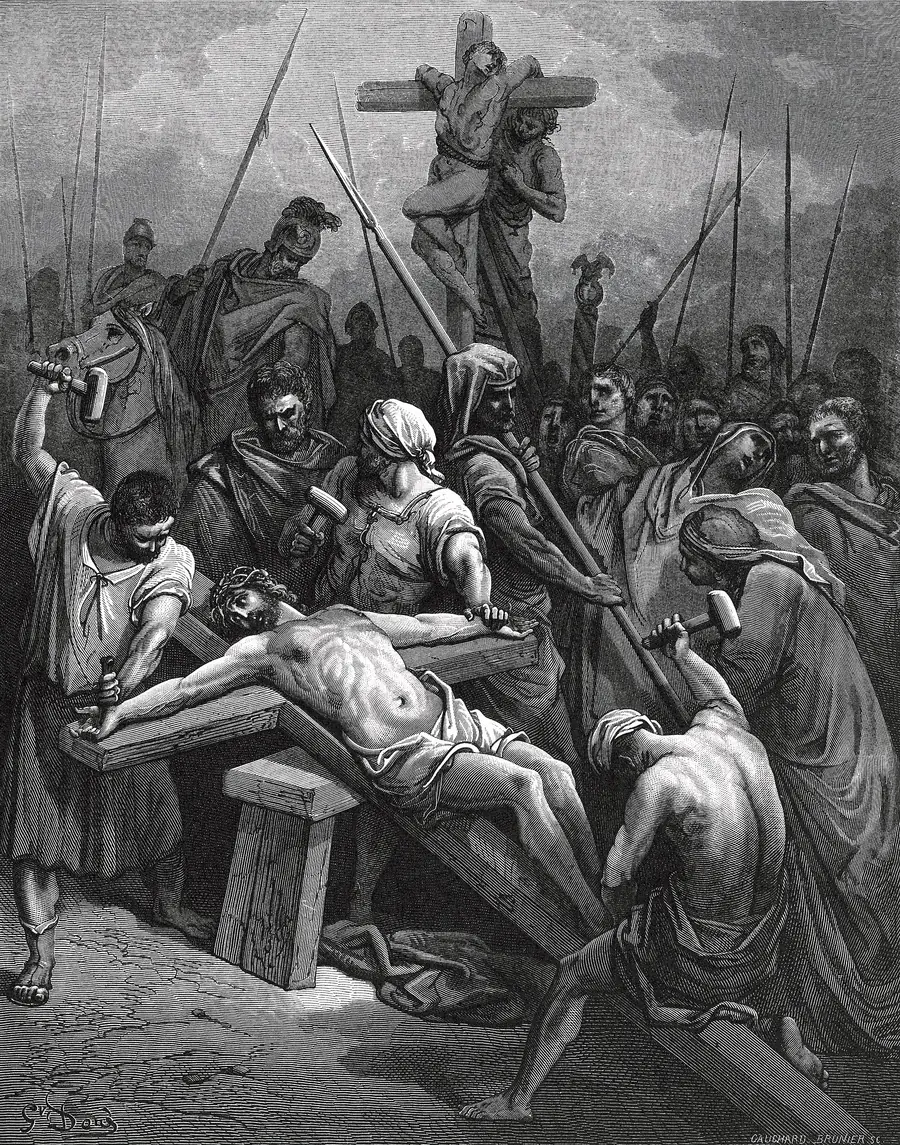
For most of its life the word simply meant a post. The execution sense is late — it attached to the word because of what Rome did with posts. This is the plain, descriptive term, and the Gospels use it for the physical object Simon of Cyrene carried.
Why this call, next. When a writer has an exact term available and reaches past it, the substitution is the message. So the question is not what stauros means but why anyone would decline it.
Behind the scenes — what your AI actually ran
ξύλον xýlon G3586, 17 occurrences — timber, wood, a stick, a tree. Abbott-Smith notes what matters most: “[in LXX chiefly for עֵץ]” — it is the Greek Old Testament’s word for the Hebrew ʿēṣ, tree.
| Where | Word used | What is said |
|---|---|---|
| Acts 5:30 — Peter | ξύλου G3586 | “whom ye slew and hanged on a tree” |
| Galatians 3:13 — Paul | ξύλου G3586 | “Cursed is every one that hangeth on a tree” |
Why this call, next. Galatians 3:13 says “for it is written” — the text names itself as a quotation. Follow it to the source and check whether the Hebrew supplies the word Paul needed.
Behind the scenes — what your AI actually ran
“The tree” there is הָעֵץ hā-ʿēṣ H6086 — the very noun the Septuagint renders ξύλον, and the noun in the curse formula קִללַת H7045.
That is why the apostles switch words. Stauros names the object; ξύλον puts the object inside a verse of the Law. Paul is not being poetic when he writes “tree” — he is reaching for the term that makes his sentence a quotation, so that “Christ hath redeemed us from the curse of the law, being made a curse for us” can rest on a text rather than on his own authority.
Greek gave the writers an exact word for a Roman gibbet, and for the physical object they used it. But where the argument turns on why the death counts, both Peter and Paul reach past it for ξύλον — the Septuagint’s word for עֵץ — because that is the word standing in Deuteronomy 21:23 beside accursed of God. The vocabulary is doing the theology: a man on a tree is under a specific written curse, and that is precisely the claim being made.
The honest limits. ξύλον is a broad word — it means timber, a club, stocks, a living tree — so its use here is not by itself remarkable; what is remarkable is where it appears. Nor does any of this settle what the object physically looked like, which the words alone cannot tell you and which this study does not touch. And note the direction of the argument: Deuteronomy is not predicting a crucifixion. Paul is applying an existing statute to an event, and saying so openly with “it is written.”
Notice what was not needed to get here: no commentary, no secondary literature, no position taken in advance.
How this study was actually made. Run — not composed from memory — by Claude Opus 5 driving Darash over MCP: word_study on G4716 and G3586, get_verse on Galatians 3:13, Acts 5:30 and Deuteronomy 21:23, get_morphology on Galatians 3:13 and Deuteronomy 21:23. Median call 37 ms.
Two words, one quotation, and the doctrine of substitution in plain sight.
A frequency count, two lexicon entries and one cross-testament quotation — all reproducible. Darash connects over MCP, an open standard, so it runs inside Claude, Grok, Cursor or whatever you already use.
A study like this rarely stays a study. Every plan includes Junifye — you and your AI writing side by side — so the notes above become a document, and the document becomes a book: typeset, light and dark PDF plus a web reader, at a permanent link under your own name. And the words you keep returning to — kaphar, olam, שֶׂה — go into Lexifye, your own dictionary, coupled to the document so a reader can click a term and read your definition of it. Darash finds it, Junifye finishes it, Lexifye defines it. That is the symbiosis, and it happens without you ever changing tools.
See plans Browse the library